Interview
20 years Health Sciences
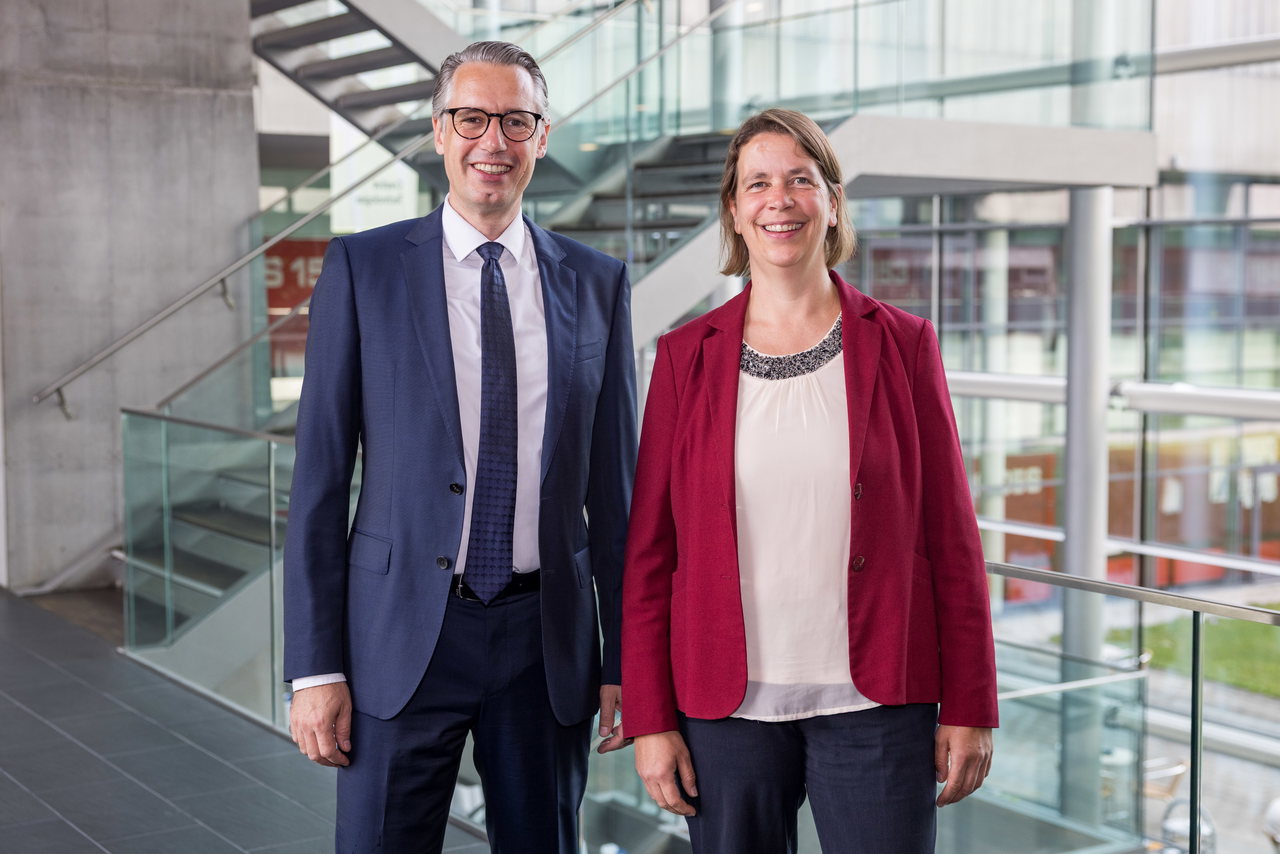
Dominik Engel, Rector of the University of Applied Sciences, and Geja Oostingh, Head of Department
Twenty years ago, academic training for the healthcare professions began at Salzburg University of Applied Sciences. Since then, it is not only job profiles and requirements that have changed. Research, interprofessional collaboration and international networking have also grown in importance. Rector Dominik Engel and Head of Department Geja Oostingh look back and ahead together: at the current and future areas of expertise of graduates, the further development of degree programmes, new courses on offer and the expansion of research.
20 years of health sciences at Salzburg University of Applied Sciences: Looking back, what has changed the most over these two decades? What impact has the shift towards academic programmes had on the professions?
Dominik Engel: The move towards academic status was important and the right thing to do. We can no longer imagine the Salzburg University of Applied Sciences without our colleagues from the Health Sciences Department. We have a strong, mutually beneficial exchange. At the same time, the demands placed on those working in the health professions are different today than they were 20 years ago. That is precisely why highly practical training remains important. We can say with complete conviction: it has been a success.
Geja Oostingh: At the outset, there was still a degree of competition between the academies and the new training programmes, including in the labour market. We have been very successful in overcoming these differences and the competitive mindset. Another key factor was the expansion of research. This would not have been possible in this form without the tertiary sector. Through research, we have significantly raised the profile of health sciences.
Listen · Question 1 of 3
20 years of Health Sciences: What are you particularly proud of?
Geja Oostingh
Head of the Department of Health Sciences
Dominik Engel
Principal of Salzburg University of Applied Sciences
Training for healthcare professions is still carried out separately. However, a topical issue at the moment is holistic healthcare – the collaboration between different professions. How do you prepare your students for this?
Geja Oostingh: This is a major challenge. On the one hand, we must comply with the legal framework, which is why much of the content remains profession-specific to begin with. At the same time, we organise modules in which students can network and practise interprofessional collaboration, for example in interdisciplinary case studies. Through these, students learn: where are my own limits, and when do I need to involve other professions?
In addition, lecturers are gradually beginning to teach on different degree programmes. For example, lecturers from the occupational therapy programme teach in the Nursing programme, whilst lecturers from the midwifery programme teach in the physiotherapy programme. This is very important for the students and represents a positive development. However, the professions will remain separate. It will not be possible to train generalists in such a short space of time.
Let’s stay with the topic of interdisciplinarity: what role do the links with other disciplines and international collaboration play?
Dominik Engel: This highlights a major strength of our departmental structure. One example is the REVELATION PhD programme, run in collaboration with the University of Salzburg, which lies at the interface between information technology and health sciences. Among other things, it focuses on IT applications, such as imaging techniques. Another example from the research sphere is the study of bark extracts at the interface between health sciences and green engineering. Overall, such interfaces are constantly emerging, and we wish to continue to foster this development. The new Master’s programme in Applied AI in Health Care, runs in partnership with PMU, which has just commenced, is evidence of this approach.
Geja Oostingh: International collaboration is also very important. With EduCare 5.0, an international project that we submitted jointly with nine other European universities, we continued to pursue the European path in 2023. At the time, the project proposal was awarded the EU’s ‘Seal of Excellence’. This has put us on the European map in the field of health research. This is also significant because a great deal of research funding comes from the EU.
And what about at the training level?
Geja Oostingh: Internationalisation also plays a major role in education. Alongside exchange programmes for international work placements and semesters abroad, long-running and successful international projects such as Go4EOT in occupational therapy or the international network for nursing staff, ENNE, have long shaped our degree programmes. We learn a great deal from this international exchange. However, we also recognise that our professions and training programmes are not recognised to the same extent in all countries. We must continue to work on this in order to facilitate international careers. EU projects can help to bring us closer together.
Which skills will become more important for graduates in the future, and how do degree programmes need to evolve to meet these needs?
Geja Oostingh: We are currently seeing new skills and greater personal responsibility being introduced across all professional groups. This is also set out in the new Professional Practices Act. One example is the interpretation of medical findings in Biomedical Sciences. We need to prepare Bachelor’s students for this now: they should have the courage to take on responsibility while recognising their limitations. To meet this growing responsibility, we need new degree programmes, particularly Master’s programmes.
Dominik Engel: I can only emphasise that. Master’s degree programmes will be essential. In the healthcare professions, we have demonstrated that we can respond quickly to needs. Generally speaking, the aim is to integrate new requirements into the curricula and to continue training graduates who can work to a high standard in the healthcare sector.
Geja Oostingh: As regards demand, I can add that we are expanding our range of courses. Our new speech and language therapy degree programme, due to start in 2027, is a step in this direction. However, as far as quantitative expansion is concerned, I am glad that we have not grown too quickly or too rapidly. In the case of healthcare and nursing, which has grown dramatically within just a few years, we have realised just what a huge undertaking such a development is.
Listen · Question 2 of 3
Which issue will have the greatest impact on the healthcare professions over the next ten years?
Geja Oostingh
Head of the Department of Health Sciences
Dominik Engel
Principal of Salzburg University of Applied Sciences
What role do the health sciences at Salzburg University of Applied Sciences aim to play in the research landscape in future, and where do their particular strengths lie today?
Dominik Engel: The province of Salzburg has developed a clear strategy focusing on life sciences and digitalisation. Both are areas of strength for Salzburg University of Applied Sciences, and we are well connected within the province in this regard. We would like to see these priority areas further expanded in collaboration with all stakeholders in Salzburg. Areas at the interface include, for example, automation-supported diagnosis, digital content in care, and health informatics. This is where the Salzburg University of Applied Sciences can make an important contribution.
Geja Oostingh: We have established two research groups since 2023. One focuses primarily on digitalisation in the healthcare system, for example in the EU projects DigiCare and THRIVE. The second has a stronger diagnostic focus. There, we are working on areas such as AI, deep learning and AI in imaging techniques. Another area of strength lies in research into plant extracts, for example in relation to skin conditions. We have built up a strong network in this field.
Collaboration is generally very important in this context. Around 70 per cent of our work is interdisciplinary. For example, we have been working with STRATEC for eight years, testing their microchips in the laboratory and supporting their development. We would like to further expand this successful collaboration.
Mr Engel, you have already mentioned the REVELATION doctoral programme, run in collaboration with the University of Salzburg. How important are seamless academic career paths for the further development of health sciences?
Dominik Engel: This is a very important development, and it also demonstrates that our researchers are able to supervise PhD students. However, one piece of the jigsaw is still missing: the Master’s programmes. We need a comprehensive range of Master’s programmes in the health sciences. In areas where we have strong research capabilities, we would also like to be granted the right to award doctorates in the future. REVELation is an important step towards this.
Geja Oostingh: We are already creating academic career paths on a regular basis. We regularly take on PhD students through collaborative partnerships. We intend to focus on this even more in future.
Dominik Engel: At the same time, a large proportion of our graduates continue to work in the field. Their roles are becoming increasingly varied, and there should be a suitable training programme for every level of qualification.
To conclude, let’s look ahead: where should the Department of Health Sciences at Salzburg University of Applied Sciences be by 2040?
Geja Oostingh: If we find ourselves somewhere in 2040, then hopefully we’ll be there together. An educational campus for health sciences would be my greatest wish. If we could be housed in a single building, interdisciplinary and interprofessional collaboration would be even easier. In terms of content, I would like to see federal or state governments fund Master’s programmes and specialisations in many fields.
Dominik Engel: I fully agree with that. In particular, I support the call for Master’s programmes, which we urgently need. I also hope our student numbers will remain well aligned with the needs of the federal state.
Listen · Question 3 of 3
What would you like to see for the Health sciences programme at Salzburg University of Applied Sciences?
Geja Oostingh
Head of the Department of Health Sciences
Dominik Engel
Principal of Salzburg University of Applied Sciences

The magazine of FH Salzburg
Editor
Fachhochschule Salzburg GmbH
Salzburg University of Applied Sciences
University Communications & Marketing
Urstein Süd 1
5412 Puch/Salzburg
Austria
© 2026 Salzburg University of Applied Sciences GmbH