Short interview
“Creativity pays off”
The Orthoptics degree programme is the smallest in the Department of Health Sciences – and regularly features in the top three in the FH Teaching Awards rankings, which involve both external and internal teaching staff. We asked the Head of the Degree Programme, Ruth Resch, what makes the teaching so strong.
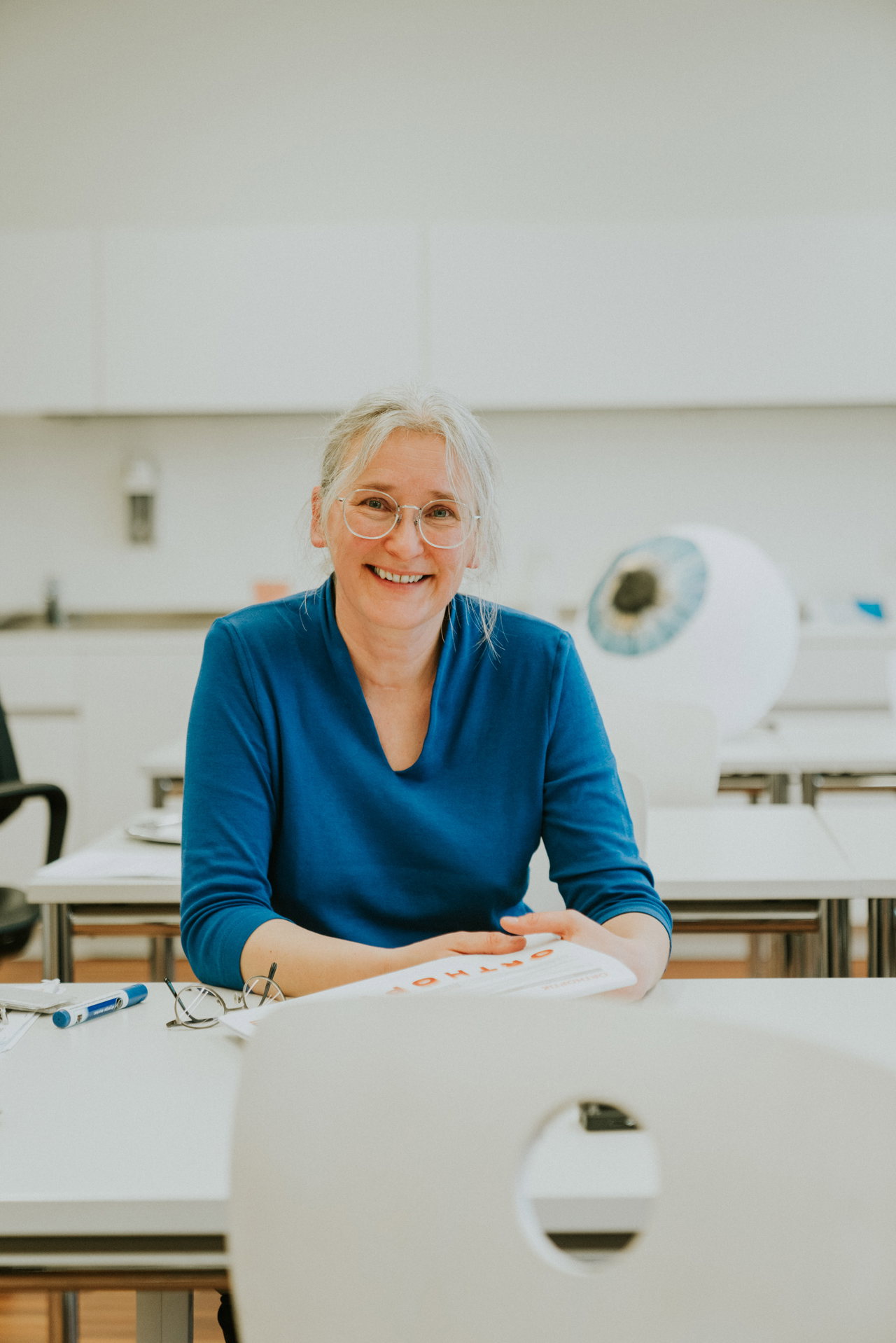
Ruth Resch, Head of Degree Programme Orthoptics
01
How has teaching changed over the past few years?
We have learnt a great deal technically during the coronavirus pandemic. Simulation is only of limited use to us. However, we are very creative in developing new learning materials. For example, I developed a ‘Schielomat’, which lets students practise the patching procedure on patients with strabismus in a hands-on way. I also created a tool as part of a bachelor’s thesis that helps students learn to examine the fundus more effectively.
02
What do students particularly value?
We use the ‘inverted classroom’ approach extensively. Students learn the fundamentals independently, while lessons focus on problem-based learning and applying theory in practice. We practise taking a patient’s medical history and interacting with patients through role-play. Students need to learn how to work with people, hold equipment correctly, and explain things clearly. It requires a multifaceted perspective, including the patient's point of view, and you can only develop that through practice, practice, practice.
03
Julia Hager has won the FH Teacher Award 2026 for her course ‘Career-Related Project’. What does she do particularly well?
She is incredibly good at inspiring and supporting her students. As part of the course, we had to plan a subject-specific, realistic conference. To me, Julia Hager makes it clear that it’s all about self-directed learning: if I’m interested because I want to learn something for myself, I’m more successful.
04
The subject is changing – what skills will students need in the future?
Gerontological orthoptics – particularly the care of older patients and those with dementia – is becoming increasingly important. At the same time, the growing use of technology in orthoptic diagnostics and the rise in vision-related complaints from digital media require special attention in our teaching.
Applications from 1 November 2026
The Orthoptics degree programme only starts every three years. Applications for the next intake (academic year 2027/28) will open this year on 1 November 2026.

The magazine of FH Salzburg
Editor
Fachhochschule Salzburg GmbH
Salzburg University of Applied Sciences
University Communications & Marketing
Urstein Süd 1
5412 Puch/Salzburg
Austria
© 2026 Salzburg University of Applied Sciences GmbH