Interview
“We must not let machines take over our thinking”
Technical systems are never neutral. That is why it is important to take ethical considerations into account when developing them. Is everything that is technically possible also permissible? Katrin Rossmann, a social scientist and lecturer in machine ethics at Salzburg University of Applied Sciences, on artificial intelligence, the potential for innovation, safety and trust in technical systems.
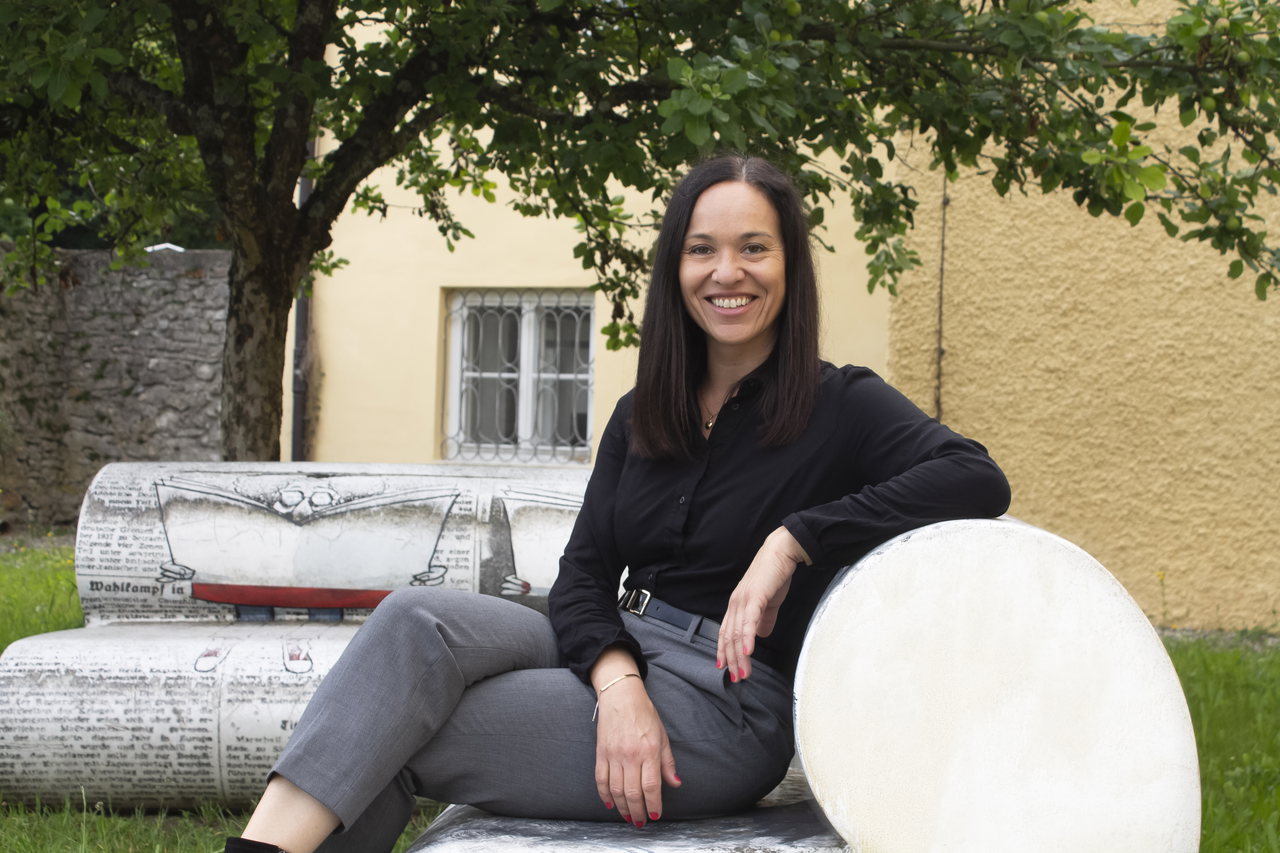
About the person
Katrin Rossmann studied sociology at the University of Graz and social work at FH Salzburg. Since 2015, she has been teaching and conducting research at Salzburg University of Applied Sciences in the Department of Applied Social Sciences and, since 2025, also in the Department of Information Technologies and Digitalisation, focusing, amongst other things, on machine ethics. She was awarded the Science Prize of the Arbeiterkammer Salzburg for her doctoral thesis at the University of Salzburg. Professionally, she has several years of experience in addiction and criminal justice support, state-funded social assistance and labour market integration. For many years, she has also been volunteering in probation support.
— Ms Rossmann, ChatGPT or Claude? Which AI do you use?
I work with various systems; it is important to me to use European providers and those authorised by my employer.
— The idea behind Claude is to give AI a constitution, or a set of ethical guidelines. How sensible is that?
In my view, this is very important. If we in Europe want to safeguard our quality of life, human rights and competitiveness, regulations are essential. Through the AI Act and the General Data Protection Regulation, Europe aims to ensure that new technologies are used in a manner consistent with human rights. However, a corresponding approach is also needed in the development of technology. We must not pit regulation against innovation.
— Why are such considerations necessary at all?
Behind this lie major philosophical questions: How do we balance values such as security, freedom and privacy? This affects many areas of computer science, such as cybersecurity and robotics. One approach to this is value-based engineering, in which ethically considered values are specifically translated into the technical design and code of systems.
— Who decides what’s good?
Which values are regarded as desirable by society is determined through political and social negotiation processes and is ultimately reflected in legislation and regulatory frameworks. Europe is committed to humanist values that ensure we can lead a dignified life even in the age of AI. If students who will go on to work in technology development are able to design technical systems but lack an awareness of humanist values, this is counterproductive to the development of our society.
— How do you convey this in your teaching?
I try to think this through thoroughly with the students: what does it mean, as a future developer, to bear responsibility? Students need to understand how values can be translated into technical design and code quality, and how spaces for reflection can be embedded as a quality feature within the development process of technical systems. To do this, they need a well-considered ethical awareness, as well as the ability to recognise conflicts of values, weigh them up critically and translate them into responsible technical decisions.
— But how can I take this into account in my work as a developer, in practical terms?
We should always ask ourselves: which users benefit from a system and which bear the risks? Who does it help? Who does it harm? This is about technology impact assessment, and it should be firmly embedded within organisations.
— Isn’t all this just a concern for a small minority?
The digital humanism movement is gaining momentum in Europe. At its core, this approach is about consistently aligning digital technologies and artificial intelligence with human values, social welfare and democratic principles. An increasing number of computer scientists are arguing that, beyond technical feasibility, we must also address the societal implications of innovation. More and more people from all corners of the world are realising that these transformative processes entail far-reaching changes for us as a society.
— These days, it’s almost impossible to buy a train ticket or carry out administrative tasks without a smartphone. How can we prevent whole groups from being left behind?
Digital technologies have great potential for inclusion, but also for extreme exclusion. They are both a blessing and a curse. In my courses on machine ethics and future-proof technologies, I try to raise awareness of this. Furthermore, there are enormous challenges in dealing with new technologies. As well as the need for a range of digital and specialist skills, there is the challenge that people sometimes place uncritical trust in technical systems, delegate decisions to machines or accept algorithmic suggestions without scrutiny. Technical competence without critical reflection can therefore create blind spots.
— After all, this is very much about security: how do we create systems we can trust?
Trust in technical systems is built through ethically considered design, transparent legal regulation and clear safety standards that ensure a responsible balance between individual freedom, data protection and societal security. Responsibility cannot simply be shifted onto users. This is where our computer scientists – specialising in cybersecurity, AI for Sustainable Technologies and robotics, amongst other disciplines – have a key role to play. Consider, for example, the use of autonomous weapon systems, the prevention of disinformation campaigns, or the development and deployment of care robots.
— How can this balancing act be achieved?
It becomes most clear when you consider how it affects you personally. How important is it to me that certain aspects of my life are protected? When facial recognition software is used in the fight against crime, people are quick to agree. But what if it’s your own face that’s at stake? Then you’re no longer so willing to give in. Once again, it becomes clear that you yourself become a participant in a process of negotiation. And once again, it highlights just how important raising awareness is in this context.
— Can values such as fairness, justice, respect or human rights even be translated into code? Does that make sense?
Let me illustrate this using the example of autonomous driving. We all agree that road traffic should be safe. The way this car makes decisions raises many ethical questions. Who is the braking intended to protect? When weighing up the options, does every human life count equally? There are countless variables that need to be discussed and taken into account. Or let’s take care robots. What is the robot permitted to do if patients behave in a way that endangers themselves or others? Should the person be restrained, even if this entails accepting the risk of injury or deprivation of liberty? These are questions that go far beyond technical programming, but which we must nevertheless address in the interests of safe systems. Computer scientists make decisions and mathematically define which values are weighted and by how much.
— It is the tech giants of Silicon Valley in particular who are resisting regulation. Are there warnings in Europe too that companies will face competitive disadvantages if they have to comply with too many regulations?
I believe the exact opposite is true. When technical solutions respond to social problems and challenges, they give rise to tremendous potential for innovation.
— What are your hopes for the future?
A great deal of time and money is currently being invested in training people to use technical systems, such as large language models. I would hope that we focus not only on technical skills, but also on developing a culture that responsibly discusses the opportunities and risks associated with the use of AI. Critical thinking requires specialist expertise and a willingness to engage with content independently, so that one can reflect on, evaluate and question the outputs of technical systems. That is precisely why it remains crucial, and I hope we can retain both the ability and the motivation to think for ourselves, and not let machines take over our thinking.
What does safety mean to you personally, Katrin Rossmann?

The magazine of FH Salzburg
© 2026 Fachhochschule Salzburg GmbH · fh-salzburg.ac.at