With Cooperation and AI Against Food Waste
In a world where around one-third of all produced food ends up in the bin, innovative solutions to reduce food waste are urgently needed. This is where the research project CEFoodCycle at Salzburg University of Applied Sciences comes in, tackling the challenge of minimising food waste through Artificial Intelligence (AI) and innovative networks.
Globally, around 30 to 40 per cent of produced food ends up in the bin, most of which comes from private households. These foods cause between eight and ten per cent of the world's green-house gases along the value chain. The CEFoodCycle project addresses the problem at the level of food manufacturers, gastronomy, and hotel businesses. "Our goal is to develop an intelligent, digital platform that connects actors within and outside the food sector," explains Eva Lienbacher, project manager of "CEFoodCycle: Mapping Food Streams and Identifying Potentials to Close the Food Cycle." "In this way, we want to promote the reuse of food and at the same time reduce food waste and CO2 emissions," Lienbacher continues. Partner organisations in France, Slovenia, Italy, Germany, and Austria are working together under the leadership of the team at Salzburg University of Applied Sciences in the EU-funded "Interreg Alpine Space" project.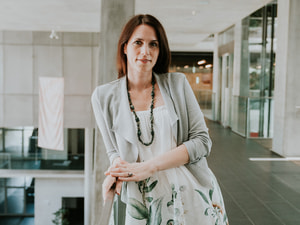
Mapping Food Streams and Identifying Potentials to Close the Food Cycle“, Eva Lienbacher, Senior Researcher am Department Business & Tourism “.
Circular Food Hubs: Nodes for Sustainable Food Utilisation
Since the beginning of the interdisciplinary and international project in 2022, so-called "Circular Food Hubs" have been established in five regions, serving as central nodes for collecting and distributing surplus food. In these hubs, various actors along the food value chain network with each other and create the necessary infrastructure to minimise food waste while promoting reuse. By providing practical solutions such as upcycling, forwarding to charitable organisations, and use in biogas plants, and through regional cooperation, they adapt to the specific conditions of each region. "A city like Nice faces very different challenges than a rural region in Slovenia," explains Anna Schliesselberger, a junior researcher in the project and significantly involved in the Circular Food Hub Salzburg-Bavaria. "France, for example, is a pioneer in legislation. For many years, supermarkets have been required to donate surplus food to charitable organisations," Schliesselberger explains. This diversity is one of the strengths of the project. Throughout the project duration, best practice examples are collected and will be published in a brochure.
Circular Economy Works: From Spent Grain to Burgers
One measure to bring companies pursuing new ideas in the food circular economy to the forefront was the "CEFoodCycle Award." Interested companies, associations, and NGOs could submit their ideas for the "CEFoodCycle Award" in May 2024. Five companies – one from each partner region – were awarded for reducing "food waste." The winner for the Salzburg-Bavaria region was the innovative cooperation between Stiegl and the startup easyVEGAN. The spent grain, a brewing by-product from beer production, is used by the startup easyVEGAN as the main ingredient for plantbased balls, patties, and burger patties. The meat substitute products made from natural spent grain are the first of their kind on the market worldwide and are produced in an especially climate-friendly manner.
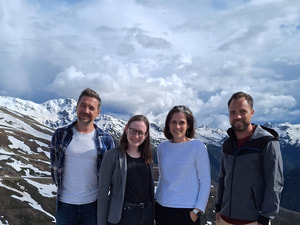
Das CEFood Cycle Forschungsteam an der FH Salzburg:
Werner Kaltner-Pomwenger, Anna Schliesselberger, Eva Lienbacher und Reinhard Portenkirchner
The AI Tool: A Preview of the Future
A central goal of the project is currently the development of foodcycle.ai, an intelligent, AI-supported tool that offers companies practical solutions for dealing with food waste. "The tool is intended to help companies efficiently utilise their surplus food," explains Reinhard Portenkirchner, junior researcher at the Department of Information Technologies and Digitalisation, who is significantly involved in developing the tool. "It suggests potential ways and partner companies that can help with the further processing or donation of the food." Companies can enter their surplus food and receive tailored suggestions for reuse – whether through donations to charitable organisations or industrial processes to upgrade food waste, known as upcycling. To ensure the project has an impact beyond its lifespan, a collaboration with an established platform partner in the residual and waste market has been established. This allows existing data to be retrieved on the one hand, and on the other hand, the developments can be integrated into the existing platform solution after the project ends.
Currently, the team is looking for companies to test the tool in everyday life. "As part of the test, companies will have access to the tool and can use it free of charge until the end of the project in 2025," explains Portenkirchner. With projects like CEFoodCycle, researchers show how sustainable solutions for global challenges can be developed through technology and cooperation. The future of food utilisation is in our hands – and in the intelligent algorithms of foodcycle.ai..
Would you like to know how the journey continues? Then, sign up for the project newsletter: Newsletter Registration