Teaching and Learning for Sustainable Development
Teaching and Learning for Sustainable Development
Salzburg University of Applied Sciences equips young people with the skills they need to actively shape a sustainable future. This commitment is reflected in the action area “Teaching and Learning for Sustainable Development”.
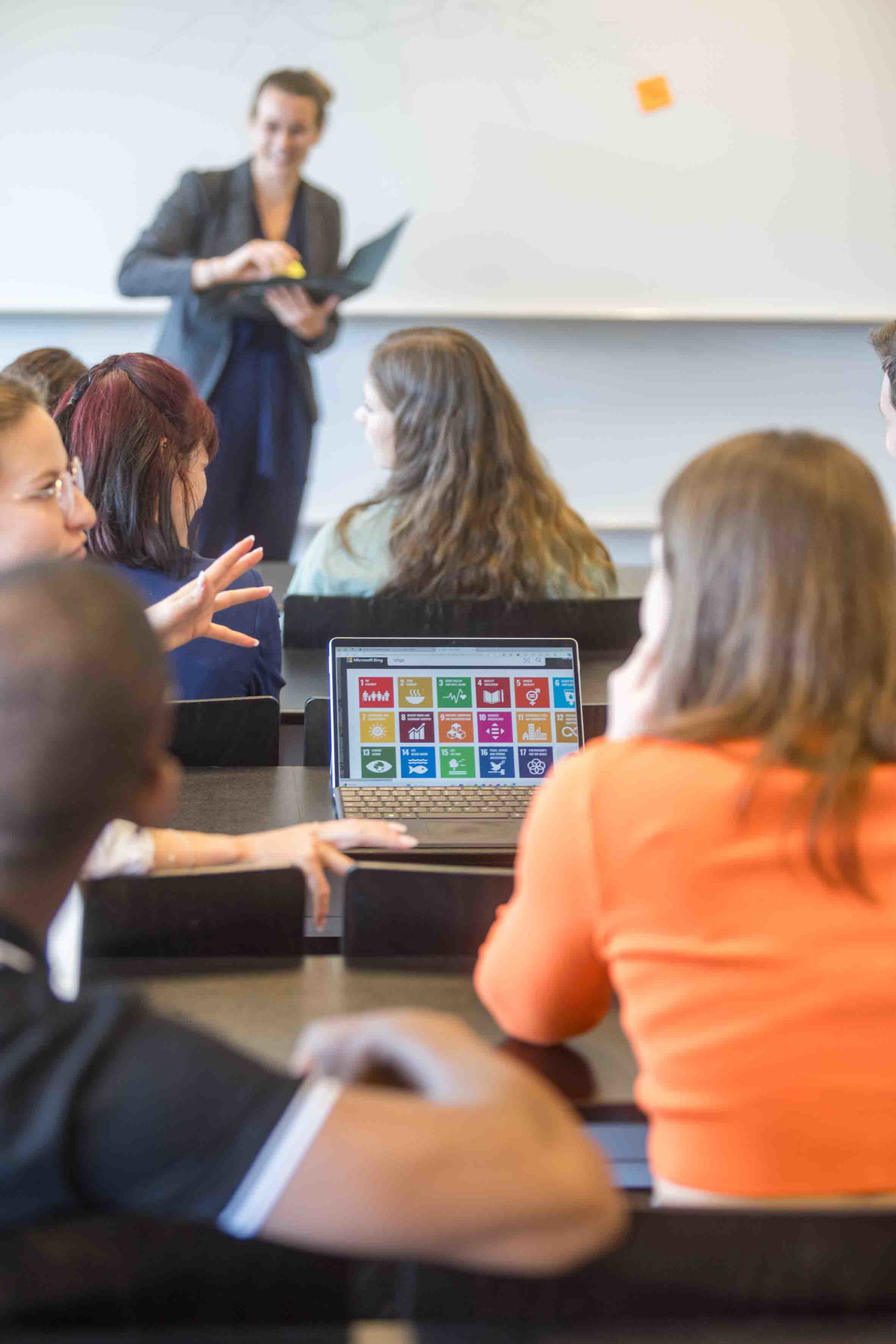
No poverty, zero hunger, affordable and clean energy, health and well-being, quality education, sustainable consumption and production, decent work and economic growth, gender equality, peace, justice and strong institutions: if we make the 17 Sustainable Development Goals the guiding principle of global action, we need a wide range of competencies. FH Salzburg aims to provide precisely this knowledge and these skills as part of its sustainability strategy.
Graduates should be empowered to actively drive the transition towards greater sustainability in their respective professional fields. That is why FH Salzburg integrates sustainable development into the curricula of all degree programmes, building transformation competencies step by step. The goal is to foster a holistic understanding of global interconnections.
This is achieved, for example, by embedding creativity, innovation, change management and personal reflection in every programme. In future, each curriculum will include at least 5 ECTS on sustainable development in compulsory courses. Symposia such as “Change.Climate.Resilience” or “Ethics & Sustainability” are part of the Bachelor’s and Master’s education.
Sustainability as a Focus Across All Study Programmes
The new Bachelor’s degree in Green Engineering is a prime example of how Salzburg University of Applied Sciences places sustainability at the heart of its educational offering. Green Engineering combines engineering, economic and ecological expertise, opening up diverse career opportunities for graduates.
In the highly sought-after field of Social Work, Salzburg University of Applied Sciences has doubled its study places at the start of the winter semester and introduced the new focus Digital Social Work as an additional area of competence. Alongside part-time programmes, full-time places have also been created.
In October, FH Salzburg signed the Planetary Health Charter, committing to promote climate competence in health education. As part of their studies, students now learn more about the impact of climate change on health and how to counteract it.
Final Theses and Sustainability
Final theses that address sustainability are actively supported. Each year, at least 20 such projects will be presented. The AK Sustainability Scholarship is awarded for theses that contribute to improving living and working conditions for people.
Networking Creates Strength
Regional and international networking with sustainability initiatives brings many benefits to teaching. High-profile experts – such as speakers from the Club of Rome – can be invited to FH Salzburg for lectures or workshops through cooperation within UniNEtZ. Alone, such additional offerings would hardly be possible.
Considering Mobility
Another aspect of the sustainability strategy in teaching is resource efficiency. Gaps in timetables should be eliminated so that students do not have to travel to campus multiple times a day. Digital systems and blended learning reduce mobility needs – and paper consumption.