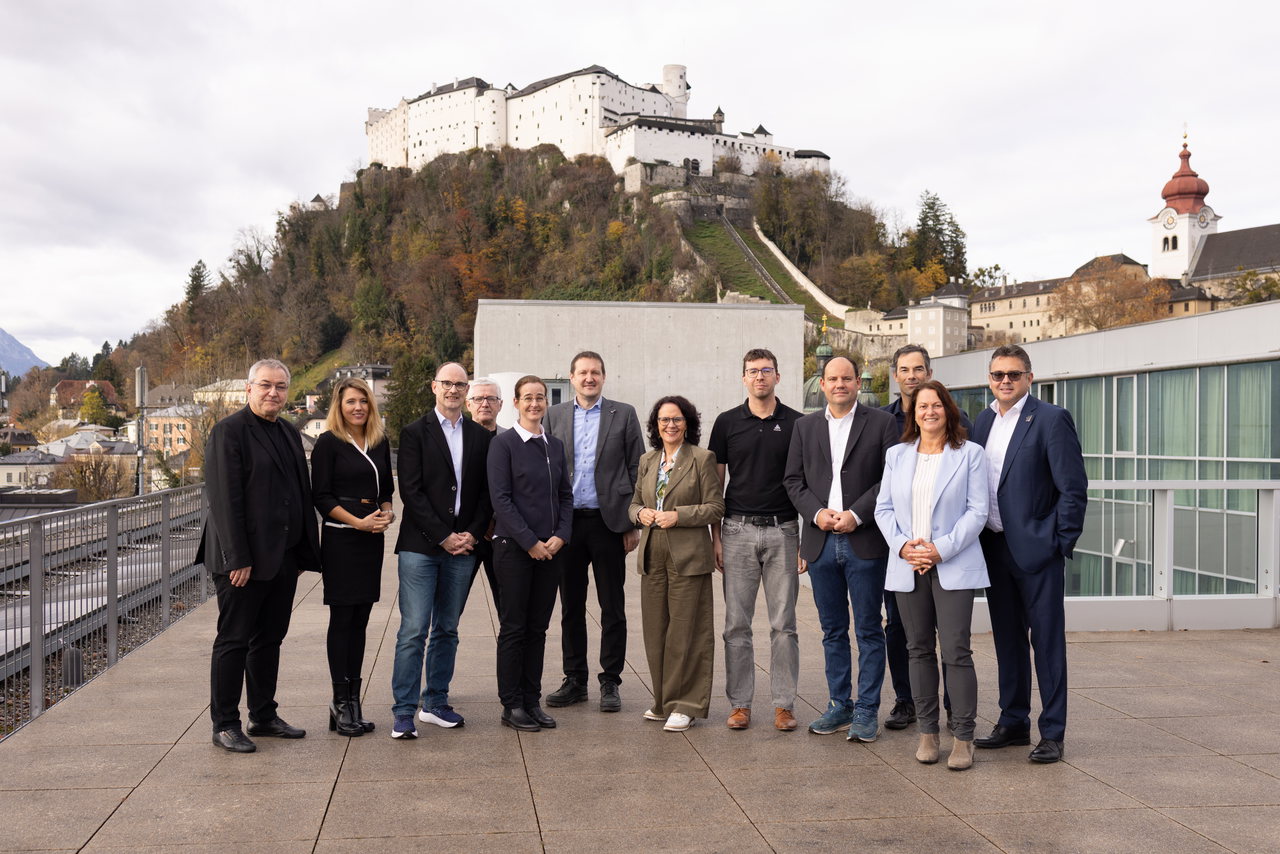
From left to right: Manfred Tscheligi (University of Salzburg), Tanja Spennlingwimmer (aws), Frank Pallas (University of Salzburg), Dirk Strunk (PMU), Elisabeth Häusler (Salzburg Research), Thomas Schnabl (FH Salzburg), Daniela Gutschi (State of Salzburg), Martin Schäler (University of Salzburg), Thomas Prinz (RSA FG iSPACE), Günther Eibl (FH Salzburg), Astrid Mayr (State of Salzburg), Walter Haas (Innovation Salzburg). (© Innovation Salzburg/Benedikt Schemmer)
Research project: EFRE research centres
New Research Centres: Turning Residuals into Resources and Advancing Cyber Security
Bringing topics such as climate protection, the use of regional resources, the circular economy, and secure energy systems even more into practice is one of the key goals of FH Salzburg’s sustainability strategy. Two newly opened Research and Transfer Centres mark another significant step towards achieving the Sustainable Development Goals.
With around €11 million in funding from the EU and the State of Salzburg, five new Research and Transfer Centres are being established in Salzburg. These centres will drive the development of key technologies in areas such as artificial intelligence, climate protection, health, tourism, and data security. The funding is provided through the EU programme IBW/ERDF – the European Regional Development Fund, which strengthens regional research capacities and knowledge transfer to industry.
Green Engineering – Sustainable Materials and Circular Economy
At the research centre “Green Engineering”, the FH Salzburg collaborates with iSPACEPlus GmbH of the University of Salzburg. Researchers at Campus Kuchl are exploring how biogenic residues such as wood scraps or bark can be transformed into economically viable products. This work has already led to innovations such as bio-based packaging, insulation materials, and adhesives.
iSPACE specialises in geoinformatics, data analytics, and visualisation. The aim of this partnership is to map where and when raw materials are available. This knowledge is essential for a functioning circular economy in Salzburg – reducing waste, cutting CO₂ emissions, and strengthening regional value creation.
Cybersecurity – Research and Transfer Centres for Data-Based Evaluation of Security and Privacy Technologies
The new Research and Transfer Centre for data-based evaluation of security and privacy technologies brings together research from FH Salzburg and the University of Salzburg. Its focus: making artificial intelligence and data-driven technologies more secure. The goal is to develop robust security and privacy measures so that companies can use AI applications reliably and responsibly.
One key area of research is so-called adversarial examples: deliberately manipulated inputs that can deceive AI systems – for instance, a slightly altered image that looks normal to humans but is misclassified by AI. Such attacks can have critical consequences, for example in automated traffic or energy systems.
The centre investigates how to detect and prevent these attacks, using methods such as robust training techniques and testing procedures for AI systems. The aim is to create practical security and privacy solutions that help businesses deploy trustworthy AI applications. This knowledge strengthens digital security and competitiveness in Salzburg and beyond – another valuable contribution to sustainable development.