Industrial Informatics as a Key to Sustainability

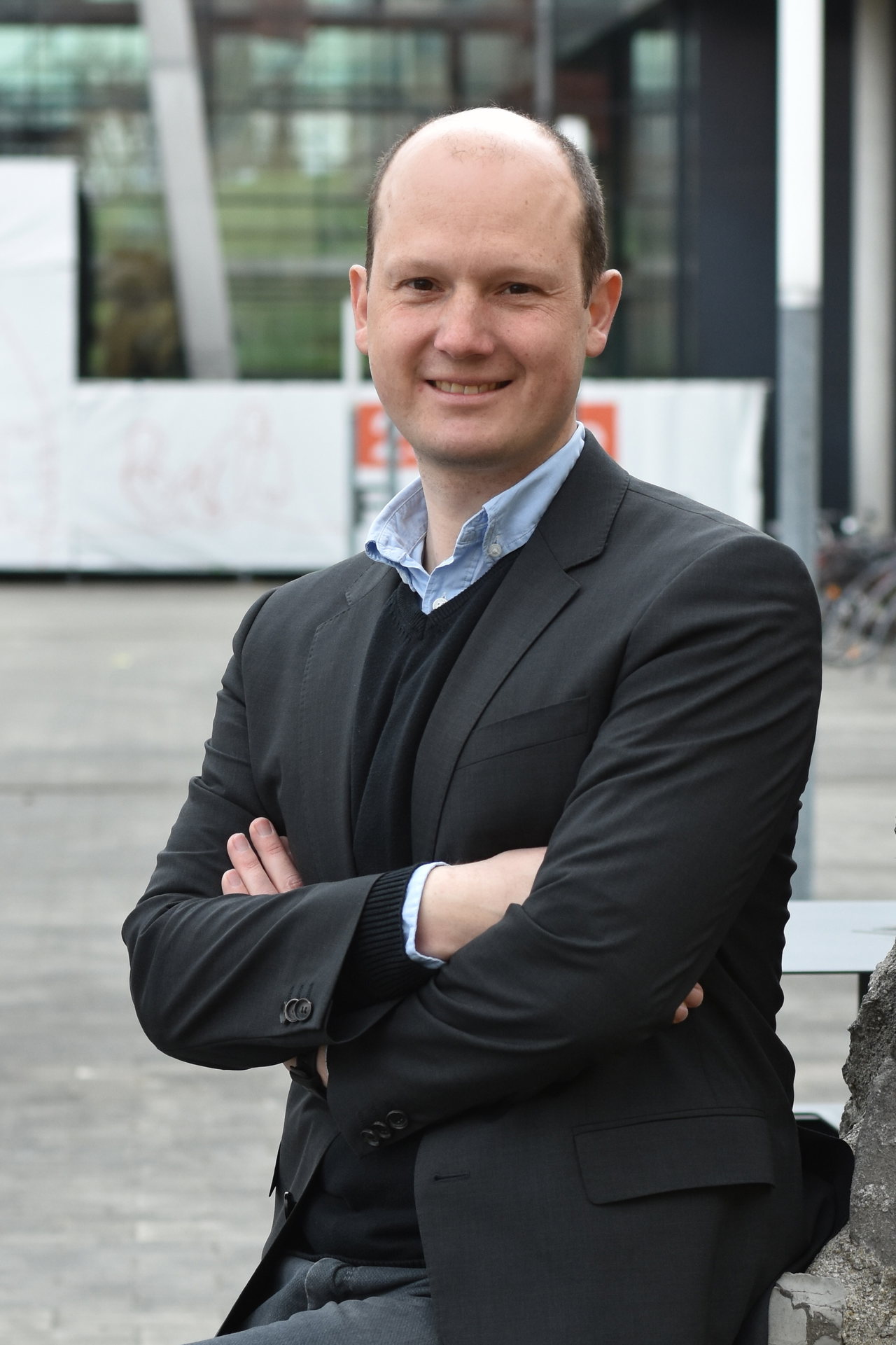
Interview mit Stefan Huber
Industrial Informatics as a Key to Sustainability
Without information technologies, the 17 Sustainable Development Goals cannot be achieved, says Stefan Huber, Head of the Research Group at the Department of Information Technologies and Digitalisation.
How does information technology contribute to greater sustainability?
I want to take a broader view and start by talking about industrial innovation in general. If we look at historical development, we can see that humanity is globally much better off today than 20 years ago or even a century ago. Significant improvements have been made across the board thanks to innovation. One example: today, 80 per cent of children worldwide receive a vaccination within their first year of life. This has been made possible by industrial innovations in the mass production of affordable vaccines. Likewise, the halving of extreme poverty over the past 20 years is closely linked to industrial innovation. For me, research and teaching in this field are therefore central to achieving the 17 SDGs. They contribute to the entire spectrum of sustainability goals – from poverty reduction and the elimination of hunger to health improvements, decent work, economic growth and peace.
What has the Department of Information Technologies and Digitalisation achieved so far?
Our research focus on “Industrial Informatics” naturally aligns with SDG 9 – Industry, Innovation & Infrastructure – in all three aspects. For example, we develop methods for intelligent and secure industrial automation. We have three research groups working on critical infrastructure, primarily energy systems, but also smart cities. You could say that our annual research volume of up to two million euros is dedicated to building a sustainable future.
What flagship projects are there?
The Josef Ressel Centre for Intelligent and Secure Industrial Automation and the Josef Ressel Centre for Dependable System-of-Systems Engineering, led by Christian Neureiter, are certainly two flagship initiatives. Beyond that, we have many individual projects, such as the EU Interreg project AI4GREEN, in which we develop methods for self-learning AI to enable increased energy efficiency in robots or individual drive axes. This contributes to SDGs 13, 12, and 7. Our research also helps us become more innovative and competitive, thereby strengthening SDG 8.
What about interdisciplinary collaboration?
Collaboration is inherent to informatics, as it rarely occurs in isolation but is usually found within application domains. One example of this is another flagship project: the FWF doc.funds.connect led by Michel Gadermayr in cooperation with the Department of Health Sciences and the University of Salzburg. Here, machine learning is being researched in the health sciences, addressing SDG 3. Other examples include collaborations with the Department of Design and Green Engineering at our Campus in Kuchl on energy systems related to SDG 7.
SDG 5 is gender equality. How does the situation look for women in informatics?
Unfortunately, the proportion of women in technical degree programmes in Austria remains below 20 per cent. However, we also have success stories: Stefan Wegenkittel has achieved a 50 per cent female quota in his degree programme “AI for Sustainable Technologies”. That is remarkable. We can learn from this, and hopefully it will help trigger a reinforcing spiral of development.
Is research for a sustainable future successfully being put into practice?
Research at FH Salzburg is always application-oriented – it’s in our DNA, so to speak. But research initially always delivers a conditional outcome. That is why the various transfer activities in our department are so important to turn this into reality. Without research and teaching, the SDGs cannot be achieved over the long term.