
Education of the future
Vision 2050: Focus Group with Foresight
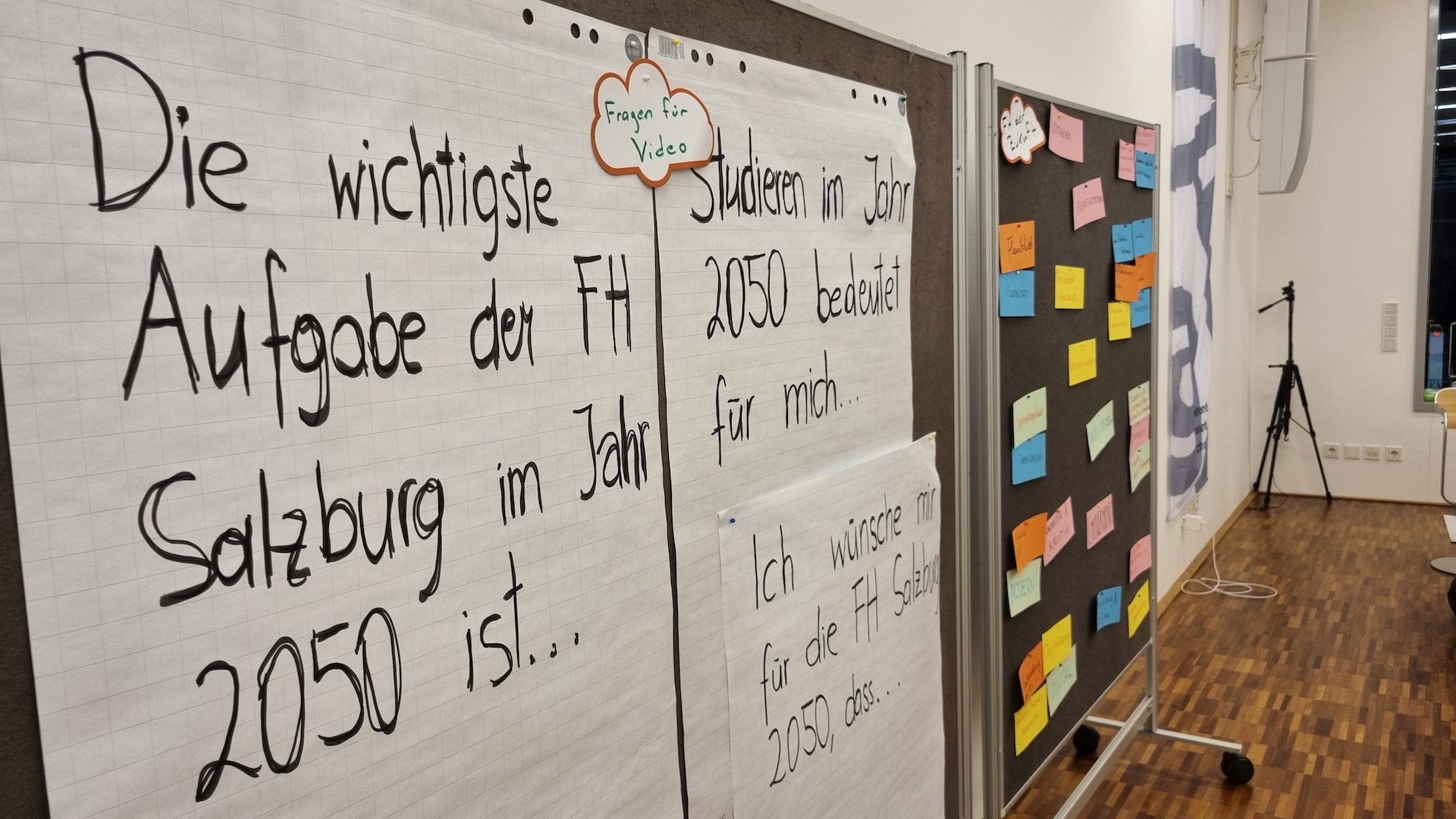
On the occasion of the 30th anniversary of the Salzburg University of Applied Sciences, FH Salzburg invited students, alumni, and staff in February 2025 to jointly analyse opportunities and challenges for the university in a workshop and to develop innovative solutions for the future.
Seven Key Challenges
Students, alumni, and staff identified seven major trends and challenges that will shape the university's future. Digitalisation naturally plays a central role and, from the group's perspective, will continue to have the most significant impact on teaching and learning. However, issues such as social inequality, educational justice, globalisation, and individualisation were also discussed. Structural change, specifically modular certificates and interdisciplinary study programmes, were also rated as central. The practical relevance and focus on specific competencies will also change the significance of academic degrees for various professional fields.
These are the areas of tension in which the university of the future will operate. Rector Dominik Engel: "Particularly interesting for us are the identified areas of tension in which we are already operating, but which will also be crucial for the future. How do we balance digitalisation and human action, create the greatest possible flexibility while maintaining a clear structure, how much theory is needed in the future, and how do we optimally prepare our students for professional practice? The university concept can certainly provide the best answers to these questions."
 Bildergalerie
- Fokusgruppe 2
Bildergalerie
- Fokusgruppe 2
Vision for FH 2050
The participants developed a vision for FH Salzburg in 2050. They see a modern, connected, and innovative university that actively involves students in the learning process, intelligently links digital and physical spaces, and drives social innovation.
"The Vision 2050 is very exciting for us and shows that we are well-positioned for the future. The content aligns with the topics at the top of our strategy. The 'what' is clear – it is the 'how' that will be decisive, i.e., finding ways for self-determined, digital, and practice-oriented learning,"
says Engel.
To achieve the vision, the group sees a key focus on infrastructure and digital innovations. A digital campus, AI-supported learning systems, and virtual and hybrid learning spaces will shape the future. However, the existing partnership with businesses and research must also be further intensified. A focus is also on sustainability and responsibility, such as inclusive educational offerings or a completely paperless campus.
"The results clearly show that FH Salzburg must be flexible, digital, and practice-oriented in 2050 to remain relevant. The university must position itself as an engine of innovation and a centre for lifelong learning by establishing forward-looking educational formats and enabling a close link between theory and practice,"
explains Dominik Engel.

Facts about the Focus Group:
- 12 participants from the groups of alumni, staff, students, and researchers
- Workshop conducted in February 2025 by the target group office
- Discussion, guiding questions, group work
- The workshop aimed to develop a common vision for the university of the future. It focused on the following questions: What role will universities of applied sciences play in the future? What teaching and learning formats are future-proof? And what competencies should the university impart? In addition, concrete ideas were developed to put this vision into practice.