
A better understanding of tourist flows
Everyone is talking about sustainable tourism. But who truly knows what guests want and how they navigate their holiday destinations? A project at Salzburg University of Applied Sciences aims to better understand tourists by visualising visitor flows.
When considering the future of tourism, Stefanie Wallinger avoids terms like “overtourism” or “visitor guidance”. As a researcher at the Department of Business and Tourism at FH Salzburg, she is exploring how the growing desire to travel can be balanced with the expectations and requirements of holiday destinations. Sustainable tourism presumes that ecological, economic and social needs are in harmony. Achieving this requires a comprehensive understanding of the wishes and needs of all stakeholders – guests, locals, businesses and employees alike. The “Data-driven Tourism for Sustainability” project, which Wallinger and her colleague Lukas Grundner are working on, seeks to enhance understanding of visitor flows. Wallinger’s fundamental question for the project financed by the Austrian Science Fund (FWF): “How can existing data be utilised for sustainable tourism development using artificial intelligence?” The initiative also involves scientific collaborators from Danube University Krems and Graz University of Technology. The consortium is rounded out by data specialists Nexyo and DatenVorsprung, as well as two tourism regions: the city of Salzburg and Bruck/Fusch im Pinzgau.
Simulating visitor flows with AI
The video shows a simulation of a whole day in August in the city of Salzburg. Attractions in green are open, those in red are closed. Blue are hotels where tourists stay overnight, yellow are so-called “agents” who move freely around the city.
Historical data is employed to simulate visitor flows in the region through the use of artificial intelligence. In Salzburg, the models are fed, among other things, with data from the popular Salzburg Card, which grants visitors access to numerous attractions for a flat fee, or from the number of overnight stays. From this, the AI calculates the movements of so-called agents – representing individual visitors – from their hotel or car park to various sights, shops or restaurants. The simulated movements can then be tracked on the screen. “This gives us a clear overview of their movement patterns within the city,” Wallinger explains. The accuracy of the simulation increases with more data sources – for instance, via mobile phone providers. The AI also simulates various scenarios, such as changes in visitor flows because of bad weather, at weekends or during events. “I can even see the impact of an attraction closing,” says Wallinger, illustrating the range of questions that the model can address.
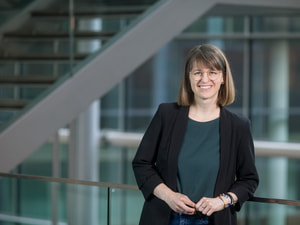
„There is a lot of data, but it often doesn't come together centrally. This means that the potential of this treasure for sustainable tourism is underutilized.”
STEFANIE WALLINGER
RESEARCHER AT THE DEPARTMENT OF BUSINESS AND TOURISM AT FH SALZBURG
Foundation for decision-making
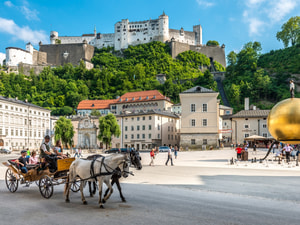
The combination of the two tourism partners, although distinctly different, adds an intriguing dimension to the project: The city of Salzburg, with its high volume of tourists and vast amounts of data, contrasts sharply with Bruck/Fusch, which has fewer visitors and less available data. While the Grossglockner High Alpine Road attracts hundreds of thousands of visitors every year, the town itself often goes unnoticed. The tourism experts in Bruck/Fusch are pondering how to draw more visitors into the town, perhaps by adding another attraction. The simulation allows them to explore and visualise various scenarios. “It provides a better basis for decision-making,” Wallinger remarks about the model, which was meticulously developed over three project years.
Existing data shows great potential
In this project, FH Salzburg primarily acts as a bridge between technology and the tourism industry. The process involved conducting interviews in tourism regions on existing data, its utilisation and concerns about sustainability. “There is a wealth of data, but it’s often decentralised, meaning its potential for sustainable tourism is underutilised,” Wallinger concludes from the interviews. The mobility of guests is a pivotal issue. For sustainable mobility options to be adopted, the quality of the experience must be satisfactory. Wallinger firmly believes that leveraging existing data to simulate visitor flows can serve as a reliable decision-making aid. From her previous projects, she has learned that visitor guidance, while often well-intentioned, frequently fails in practice. Therefore: “The benefits must take centre stage. Guests are more inclined to accept alternative offers if they promise a special experience or come with shorter waiting times.”