
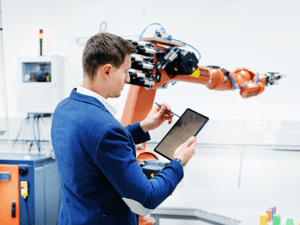
As a layperson, it’s hard to imagine what industrial informatics is. Where do we come across this topic in our everyday lives?
Consider the many smart home applications, for instance. Smart speakers, lights and fridges collect information to simplify daily life. The multitude of convenience and safety features in today’s connected cars is another example. Intelligent vehicles can recognise traffic signs or measure distances. This same transformation towards cloud solutions, artificial intelligence and ever more sophisticated control systems is happening in manufacturing. The industrial sector and IT are merging more and more, leading to what we call Industry 4.0.
Can you give us an example?
Applications could include the autonomous control of entire production lines or the automation of maintenance and service tasks, for example. Two years ago, in collaboration with industrial partners in Salzburg, we established the Josef Ressel Centre for Intelligent and Safe Industrial Automation to tackle issues like information transparency, networking, decentralised decision-making and technical assistance in manufacturing.
What is the difference between Industry 3.0 and the next stage, Industry 4.0?
Industry 3.0 focused on creating fully automated production lines with robots and programmable logic controllers using IT. Industry 4.0 takes this a step further; we aim to achieve autonomous manufacturing. Our vision is a manufacturing environment that largely operates independently to manufacture the desired products. This encompasses artificial intelligence, security and modern OT (Operational Technology) architectures with cloud connectivity. In this case, OT means IT tailored for machines and manufacturing systems.
What are the challenges?
Networking of systems presents inherent risks and requires systems that are secure against cyber attacks. Additionally, artificial intelligence is a vast field that will drive many innovations in manufacturing. All these challenges and tasks call for professionals with expertise in industrial automation, robotics and IT.
Where is this development heading?
Today, we can manufacture high-quality products through partially or fully automated industrial processes. Automated production by robots makes affordable smartphones possible. Jobs are shifting from manufacturing roles to control and monitoring roles. However, the evolution goes beyond manufacturing applications. Industrial IT can assist service employees, for instance, by automatically reporting which machine has broken down or which part is defective. This speeds up repairs as the necessary spare parts are identified immediately, and troubleshooting can start without delay.
What other fields of application are there?
Predictive maintenance is an exciting area. Using appropriate software, a machine can automatically detect when an oil change is needed, for example. Instead of waiting for something to break, maintenance is performed at the optimal time. The goal is to find the best and most efficient solutions for industrial processes. This requires people with strong analytical skills, which is exactly what we try to impart to our students.
In which areas are graduates of the master's programme needed?
There is a significant demand in the industrial sector. In Salzburg, we are fortunate to have many innovative companies that tackle issues related to industrial informatics and robotics, such as Copadata, Sigmatek, B&R and Palfinger. These companies collaborated with us to develop the master's programme, and we’ve maintained a close working relationship with them for years.
Where will industrial automation and industrial robotics be in five or ten years’ time?
I believe that artificial intelligence will significantly enhance robots, making them better and more reliable. Systems will become smarter, more secure and potentially more autonomous. We will also see greater interconnectivity of services and capabilities. Predicting where we will be in 20 years is hard, especially given the disruptive developments from generative AI models like ChatGPT that we’ve witnessed recently. However, I am confident that today’s students will play a vital role in optimising these systems further. They will actively shape the future of the industrial sector using the latest technologies.